I combine data-pipeline engineering with empirical research on LLM training-data quality, reward and verifier reliability, and scaling-aware evaluation. My research also includes controlled MoE pretraining experiments.
I am a Software Engineer II at Microsoft and bring five years of data-pipeline experience. I have led architecture and deployment of production workflows combining evidence processing, specialist agents, report validation, and human review.
At the smallest scale, joint tuning reduced Muon-SW's advantage from 0.035 to 0.0026 BPB—about 90% of the gap disappeared (95% CI: 0.0018–0.0034). The surviving share rose from roughly 10% to 21% across the tested ladder; larger-rung estimates use single-seed sweeps.
Data & method
81 runs across 3 MoE rungs, 1.9M–15M active parameters; source-scaled data and joint LR/WD tuning, with 4 paired seeds at the smallest tuned rung.
On synthetic box-swap tasks, Qwen3 answer reliance on written reasoning rose from 16–18% at 0.6B to 97–100% at 14B. Reliance correlated with step accuracy (r = 0.99); base/post-trained Qwen3 differences were at most 0.03 from 4B upward.
Data & method
25 open-weight models/checkpoints from 4 families, 7,200 evaluation items each; exact-ground-truth tasks and controlled CoT edits, inference only.
No tested semantic threshold met the 90% conservative-precision target on calibration. The existing judge-adjudicated policy achieved 98.1% resolved precision and 98.2% candidate-frame recall on held-out corpora—not corpus-wide recall.
Data & method
16 corpora with 1,673,514 corpus-specific items, 6 benchmarks, 8 policies, and 594 blinded dual-reviewed pairs; disjoint calibration/held-out sets.
Surface features weakly distinguished answer provenance (AUROC 0.562), but the unmodified-data policy showed no exploitation advantage: gaps were 0.021 vs. 0.027 for the matched control. A detectable artifact was not shown to be exploited under the tested budget.
Data & method
315,499 GooseReason-0.7M answer options, 5 surface features, and 2 policy-training arms with equal dataset sizes and a fixed budget; paraphrase-matched control.
Within-group verifier-error correlation was 0.530 (95% CI: 0.500–0.560), implying 1.70 effective samples per group of 8 under an exchangeable-error model. Advantage-sign disagreements affected up to 0.83% of groups; shared prompt difficulty and answer form were not disentangled.
Data & method
24,998 groups of 8 Qwen2.5-1.5B completions across MATH, GSM8K, and DeepMath-103K; correlation estimation and advantage replay across 4 rule-verifier configurations.
Self-validation ranged from 53.8% to 95.2%; two same-library configurations disagreed on 49.9% of pairs. Whitespace/punctuation caused 93.0% of default LaTeX in-contract failures; the reference numeric cascade accepted all tested off-by-one cases at magnitudes ≥104.
Data & method
307,420 verdicts across 4 verifier implementations; certified-equivalent and adversarial answer transformations, with category-level audits separating rejection from execution failure.
Engineering delivery alongside independent research, with an emphasis on evidence, reliability, and human decision boundaries.
Microsoft · Project lead · Shipped
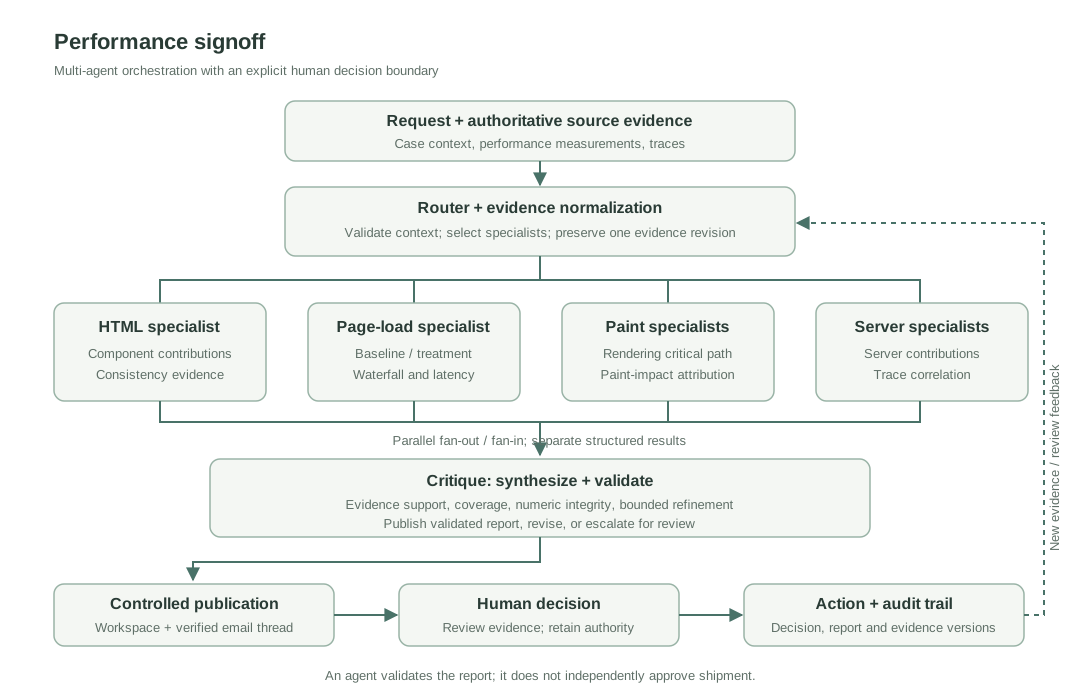
Performance Signoff Multi-Agent System
Led architecture, deployment, and iterative refinement of a production performance-investigation workflow. A router prepares shared evidence, parallel specialist agents investigate performance signals, and a critique stage validates the report before publication. The final signoff decision remains with a human reviewer.
10 → 3 days
Time to resolution 70% reduction
>60%
Previously manual workflow steps automated
400 cases
Six-month measurement period
Public-facing architecture overview; internal service names omitted. View full size.
Operational results reported for a 400-case, six-month measurement. Time to resolution and workflow-step automation are distinct measures; neither is presented as a developer-hours saving.
Contact
For conversations about LLM training systems, data quality, and evaluation reliability: